








Jun 14, 2026
As cases of New World Screwworm infestation grow, we want to keep our supporters informed as fast we can. We are very concerned about the lives of pets in Texas. What we see during disasters like this is that pets in shelters are often forgotten about or seen as “unfortunate casualties.” Our job has always been to ensure that doesn’t happen.
Consequently, right now, Austin Pets Alive! is enacting emergency measures to deal with the growing disaster of the New World Screwworm infestation in parts of Texas and New Mexico.
This critically affects our work because we are the only lifeline for some shelters in the infested areas and we rely on transport out of state to save many lives in Texas. Both of those transportation arms are in jeopardy.
The Situation
Here is why the screwworm fly is a problem, including for companion animals. It lays eggs in decaying matter just like normal flies do but the larvae (maggots) then eat the live tissue as well. The flies we are familiar with do not do that. Currently, when a wound is treated, it stops regular maggot activity. In New World screwworms, they don’t stop once an infection is healed. They keep eating all the tissue around the wound and specifically target healthy tissue. This creates wounds so big that it kills animals, especially vulnerable animals like babies and sick/injured/elderly animals. It is incredibly painful, too.
Here’s the bottomline for us. We are here to save lives and even though this is scary we are not going to let it deter our mission to save the lives of pets in shelters who will not live without our programs.
Thankfully, there are steps we can take to be sure we are protecting the pets in our care, and prevent accidentally bringing screwworms to Austin and still save lives at the same time. It will be very hard and be a lot more expensive than our normal operation.
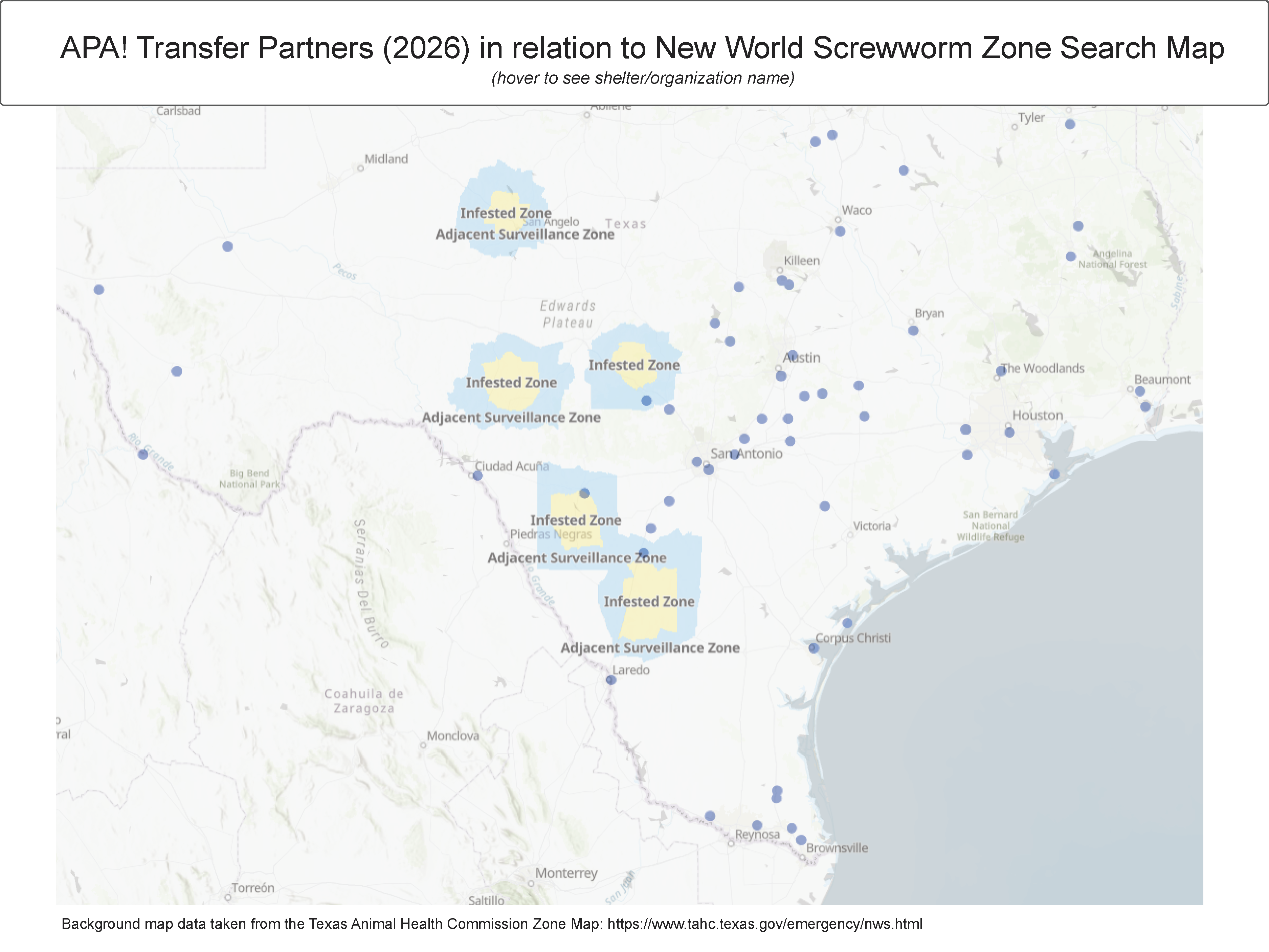
Our current transport map overlaid onto the infested areas shows that not only are some of our partner shelters in those areas but many are very close by and will likely be affected very soon. We need to prepare for that.
Our Plan: Protect Pets & Meet State Regulations
To keep our promise to pets while working within the Texas Animal Health Commission (TAHC) regulations for transport of animals, we have launched a proactive operational plan. While these new requirements are costly and labor-intensive, they are essential to saving lives:
- Navigate Inspection Deadlines: Currently, no animal in an affected county for more than 24 hours can be moved from the county without an inspection certificate. We are required to initiate our inspection request at least 5 business days before the planned transport during an exceptionally busy time for the state. This may take a very long time if they are very busy. Once the official inspection occurs, the movement certificate is valid for 5 days, so transport must occur within that window.
-
The reason this is a costly problem is that the shelters we are supporting in these areas are euthanizing animals because the animals run out of time before they need the cage space for a new incoming animal. These regulations may result in 2-3 times the wait time before we can bring them to our facilities. Our strategy has always been to “beat the clock” so we move on fast timelines to remove animals from those facilities so that they are not clogging up kennels resulting in deaths of other animals and they are not in more danger of euthanasia themselves. This means that we will need to figure out more holding spaces and care for more animals so that they are not simply being killed when they run out of time.
-
-
Enhanced Medical Screening: Every animal must be microchipped and treated with a very expensive oral parasite medication called NexGard or Credelio within the last 30 days in order to receive a travel certificate. This may result in them needing multiple doses before we even get them on the van to leave that area if it takes weeks to get a certificate. To ensure this happens, we need to deploy more people, and more often, directly to these facilities each week to provide those treatments, rather than waiting for them to arrive at our APA! Transport Hub in Elgin.
-
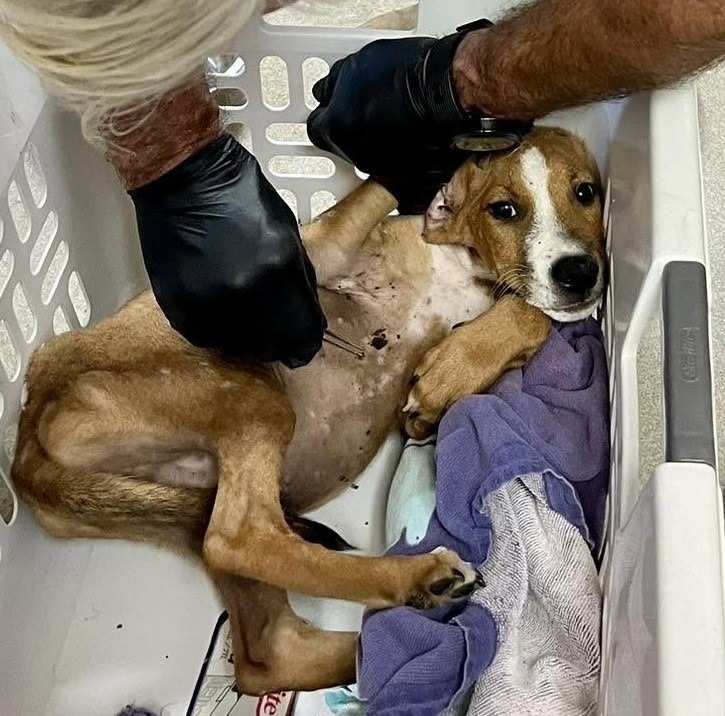
Enhanced Parasite Protection: Many animals from rural Texas shelters arrive with wounds and are covered in ticks and fleas. All animals arriving in this shape, or from an infested area, will also be treated with Capstar just in case they have burrowing larvae we can’t see. It is not unusual to see dogs and cats covered in ticks (see photo below) from very rural Texas and we will need to treat them if they have any skin penetrations at all.
-
Increasing Veterinary Capacity: We are determining if any of our veterinarians can be certified as TAHC inspectors. This may become more likely as the state of TX tries to expand who can help. We will need to hire relief veterinarians to help us handle our current load and support the affected shelters if we get the greenlight and the official channels move too slow to use their officials only.
HOW YOU CAN HELP
Financial Support
Our top request now is monetary donations. In order to save lives and prevent pets from falling through the cracks, early cost estimates are above $300,000 if we want to do this right. If you can donate, please donate here or reach out to us at [email protected]. You can also Venmo us @austinpetsalive *Please watch out for fraudulent donation accounts, only @austinpetsalive is us.
Immediate costs include:
-
Overtime for staff, supplies/medications, travel for staff, contract support, transportation costs (fuel, vans, temporary drivers, and maintenance).
-
Vans: We need at least one more van (preferably two) that we can put into action immediately. These are specialty outfitted and wrapped and cost about $95,000 each. They can easily hold 50-100 animals per trip. These do take time to order so the sooner we get the order in the better. Unfortunately, already heavily used vehicles are too unreliable for long trips. Ideally, there is also funding for maintenance which runs about $40,000 per year per van.
-
Drivers: we need at least two more drivers that can help pick up more animals and do more frequent visits to these small towns scattered across the state. Expected costs are around $50,000. Vans only help us if we can operate them.
-
Van rental: before new vans arrive, having the flexibility to rent vans would be tremendous and currently we estimate that to run around $10,000 per month.
-
Medications: just our initial purchase of Capstar (kills maggots that already exist instantly) and Nexgard is $9000.00! We expect this to dramatically increase due to treating not only our incoming pets but all of our current pets.
Fosters
We really need fosters! We are likely to house and care for pets longer before transporting out of state and there will not be enough room in our shelters or at our partner shelters. To foster, please stop by our TLAC location at 1156 West Cesar Chavez any day between noon and 6:00 p.m. You can also complete an application. Foster a Dog; Foster a Cat; Adopt a Barn Cat.
Volunteers
Volunteers have always been the reason behind why we’re able to save so many lives. In times of crisis, those needs increase. Here are a list of volunteers needs:
-
Drivers: We will need drivers to help us with pick-ups and supply deliveries since we will need to go to each region more often). We will also need more help with regular transport within Austin and between Austin and the closer shelters (surrounding counties) while all this is taking time from our regular operations. We will let you know how we can best use your help once you sign up.
-
Animal care support: walking dogs, cleaning, doing laundry, feeding animals, learning how to match and send home animals with fosters/adopters and care for hospitalized pets.
-
New volunteers: sign up online at austinpetsalive.org/volunteers or just walk up to our TLAC location 1156 West Cesar Chavez, noon-7pm any day.
-
Existing volunteers: please sign up in My Impact or feel free to just show up, we’ll put you to work!
-
This is not like other disasters that we have responded to. This will likely slowly spread across many counties in Texas and travel sanctions may last months. We literally cannot do this without you.
Thank you for caring about the pets in Texas. They deserve to live through this disaster and we are single-minded in ensuring that they do.
Source: Austin Pets Alive